DJI Battery Cycle Life Explained: What a Charge Cycle Actually Counts
Two flights that each use half the pack count as one cycle, and letting the battery discharge itself in a drawer counts too. Here is the arithmetic DJI actually uses.
A DJI flight battery records one charge cycle every time it has discharged a cumulative 75% of its rated capacity. Not one charge. That single rule explains almost every surprise owners have about cycle counts: two flights that each use half a pack equal one cycle, a pack flown 40 times at 50% depth has logged roughly 20 cycles, and a battery that quietly self-discharged to storage level in a drawer was counting the whole time. Get the arithmetic right and the warranty line, the "800 cycles" claims on third-party spec sheets, and the moment to retire a pack all start to make sense.
The 75% rule, in practice
DJI publishes the counting logic on its own support pages: a cycle is logged when the battery has released 75% of its nominal capacity in total, and the counter includes energy lost to the pack’s automatic self-discharge. The table below is the same rule applied to the discharge patterns people actually fly.
| What you did | Cycles logged | Why |
|---|---|---|
| Flew from 100% down to 25% | 1.00 | Exactly 75% released — the textbook case |
| Flew from 100% down to 0% | 1.33 | Discharge past 25% still counts |
| Flew 50% → 0%, twice | 1.00 | Partial discharges accumulate |
| Flew 100% → 60%, five times | 2.00 | Shallow flights still add up |
| Left a full pack to self-discharge to 60% | ~0.53 | DJI counts the automatic discharge |
| Used the pack as a power bank in the hub | Counts | Energy out is energy out — DJI says so explicitly |
Two practical consequences follow. First, flying to 30% instead of 10% on every flight genuinely halves the cycles a pack logs over a season — it is the same saving as buying twice as many batteries. Second, a low cycle count is not proof of a healthy pack: a battery that sat at 100% in a hot car for a year can be badly aged with almost no cycles on the counter.
Where to read the count
The counter is in the app, a few taps deep. In DJI Fly, open the camera view, tap the "..." menu in the top-right corner, choose Safety, then scroll to Battery Info. In DJI GO 4, the path is Settings → the battery icon → Battery Details. Both screens show the charge-cycle count alongside cell voltages and temperature. We walk through the readings in more detail in how to check battery health in the app, including what to do when one cell drifts.
The number that ends your warranty: 200
DJI’s consumer flight-battery warranty runs for 12 months from purchase and covers the pack only while it has logged fewer than 200 charge cycles — for FPV, Avata and Neo packs the published threshold is even lower, at 100 cycles. Whichever limit arrives first ends the coverage. The full terms, including what is excluded, are laid out in what the DJI battery warranty actually covers.
The crucial point is that 200 is a warranty boundary, not a service life. DJI’s own support material says plainly that a battery past the warranty cycle count can keep flying, and that flight time simply declines as the counter climbs. A pack at 250 cycles that still meets your flight-time needs is not a safety problem — it is a pack you now pay to replace if it fails.
200, 300, 800: what each number is really claiming
Spec sheets quote cycle figures for different purposes, and comparing them without knowing which is which leads to bad decisions.
| Number | Where it comes from | What it means for you |
|---|---|---|
| 200 cycles | DJI warranty terms for consumer packs | A coverage threshold, not a life limit |
| 100 cycles | DJI warranty terms for FPV / Avata / Neo packs | Same — higher-draw packs get a shorter line |
| 800+ cycles | Supplier specification sheets for the grade-A cells we use | A cell-level rating to 80% capacity under lab cycling, not a warranty promise |
| Capacity below 80% | Our own warranty wording | The threshold we replace on, inside 12 months |
An 800-cycle cell rating and a 200-cycle warranty threshold describe different things: one is a laboratory statement about the cells, the other is a commercial promise about the product. Neither is a guarantee about your flying style, because heat, storage voltage and discharge depth move the real number far more than the cell rating does. Every product page we publish carries the supplier cycle figure so you can weigh it yourself.
Calendar ageing: the clock that runs whether you fly or not
Capacity is lost two ways — cycling and time. Cell chemistry ages faster at high voltage and high temperature, so a pack stored at 100% in a warm room can lose several times more capacity per year than the same pack stored at 50–60%. That is why a battery used twice a year can still be disappointing: its cycles are low, its shelf life is not.
The practical rule is to treat storage as an active decision. Charge to roughly 50–60% if you are not flying this week, keep packs out of hot cars and off sunny shelves, and rotate them so every pack gets used rather than one pack absorbing all the flying. The habits that slow both clocks are covered in nine habits that extend battery life.
What burns cycles fastest
- Deep discharge — routinely flying to auto-land costs cycles and stresses cells in the same flight.
- Heat — a pack flown hard at 35 °C ages faster than the counter suggests.
- Storage at 100% — no cycles logged, significant capacity lost.
- Charging a hot pack straight after landing — let it rest 20–30 minutes first.
- Charging slowly or topping up repeatedly — small losses, but they are not free.
When the counter justifies replacing a pack
| Cycles logged | What to do | Why |
|---|---|---|
| Under 200 | Fly it, log flight times | Inside warranty; no reason to change anything |
| 200–500, flight time within 15% of new | Keep flying, plan a replacement | Normal decline; keep it as a backup pack |
| Over 500, or 20%+ less flight time | Replace for anything critical | Margin on mapping and commercial work is gone |
| Any count, cell spread over 0.10 V | Stop flying it | Imbalance under load is how packs fail in the air |
| Any count, pack swollen | Retire it now | Gas build-up is a fire risk — see the swollen-battery guide |
Do not chase a low cycle count
Because the counter only advances on discharge, it is possible to log very few cycles by storing packs at moderate charge and flying shallow. Do that to the extreme and you have simply stopped flying. Cycles are one of two clocks; the other is time, and the damages from a year on a warm shelf at full charge do not show up on the counter at all. Use the number as a maintenance prompt, not a score.
Do third-party packs report a cycle count?
Yes, when the pack is built with a proper smart-battery controller, which is what makes it readable by the aircraft at all. The counter lives in the pack’s own board, not in the app, so a third-party pack that completes the handshake reports charge, cell voltages, temperature and cycles in exactly the same three taps of the Safety menu. It is worth checking on any pack you buy: a battery whose count never moves, or resets between flights, is telling you the controller is not reporting honestly, whatever the spec sheet claims.
Products mentioned in this guide
Third-party universal packs, priced at 60% of DJI official — 12-month warranty, free express shipping over $99 in most markets.
 Hot
Mavic 3 Universal Flight Battery
5000mAh · 46 min long endurance
 Universal
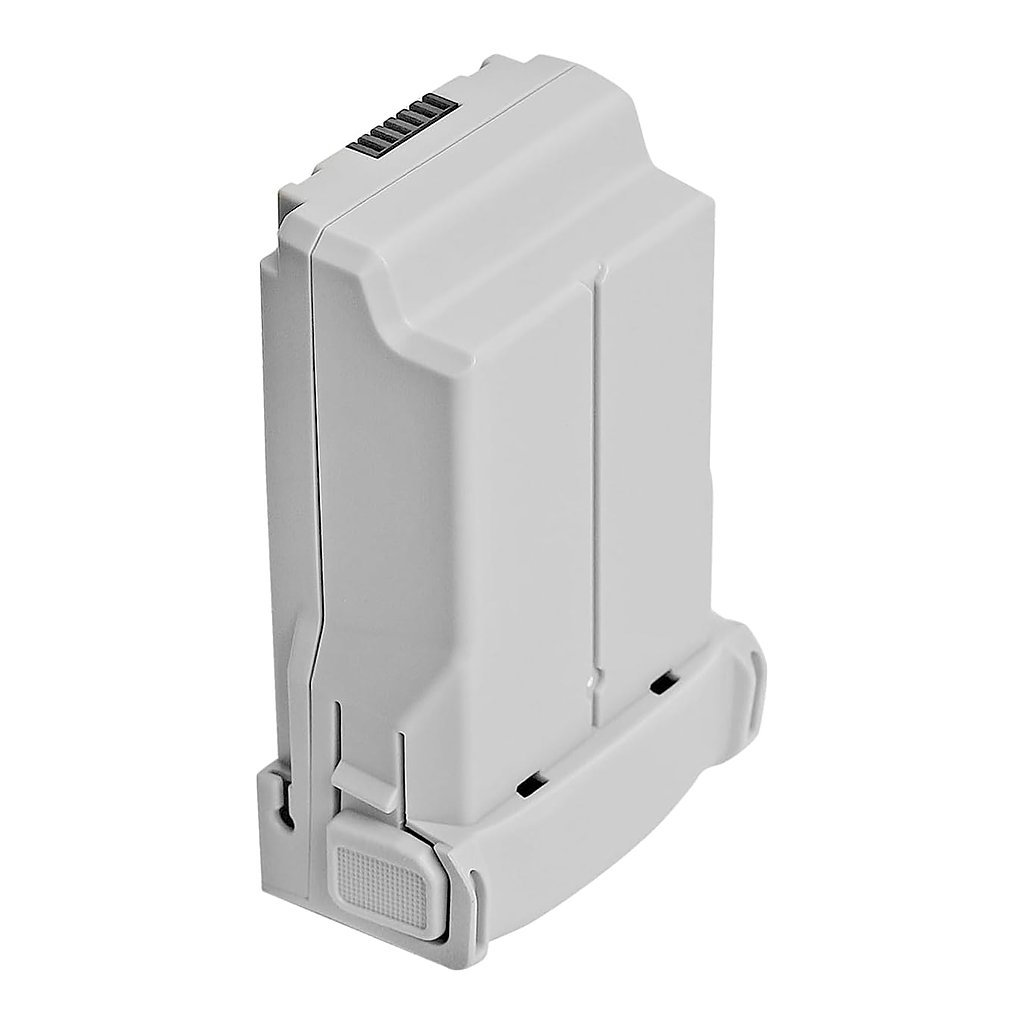
Mini 4 Pro Extended Battery
3850mAh · up to 45 min flight time
 Hot
100W Multi-Port Battery Hub
Charge 3 batteries simultaneously
Frequently asked questions
How many charges is one DJI battery cycle?
Does DJI stop covering a battery after 200 cycles?
Does your 800-cycle rating mean the battery outlasts a DJI pack?
Get the next guide — and 15% off
One email when we publish something worth reading, plus a 15% code for your first order. Unsubscribe any time.